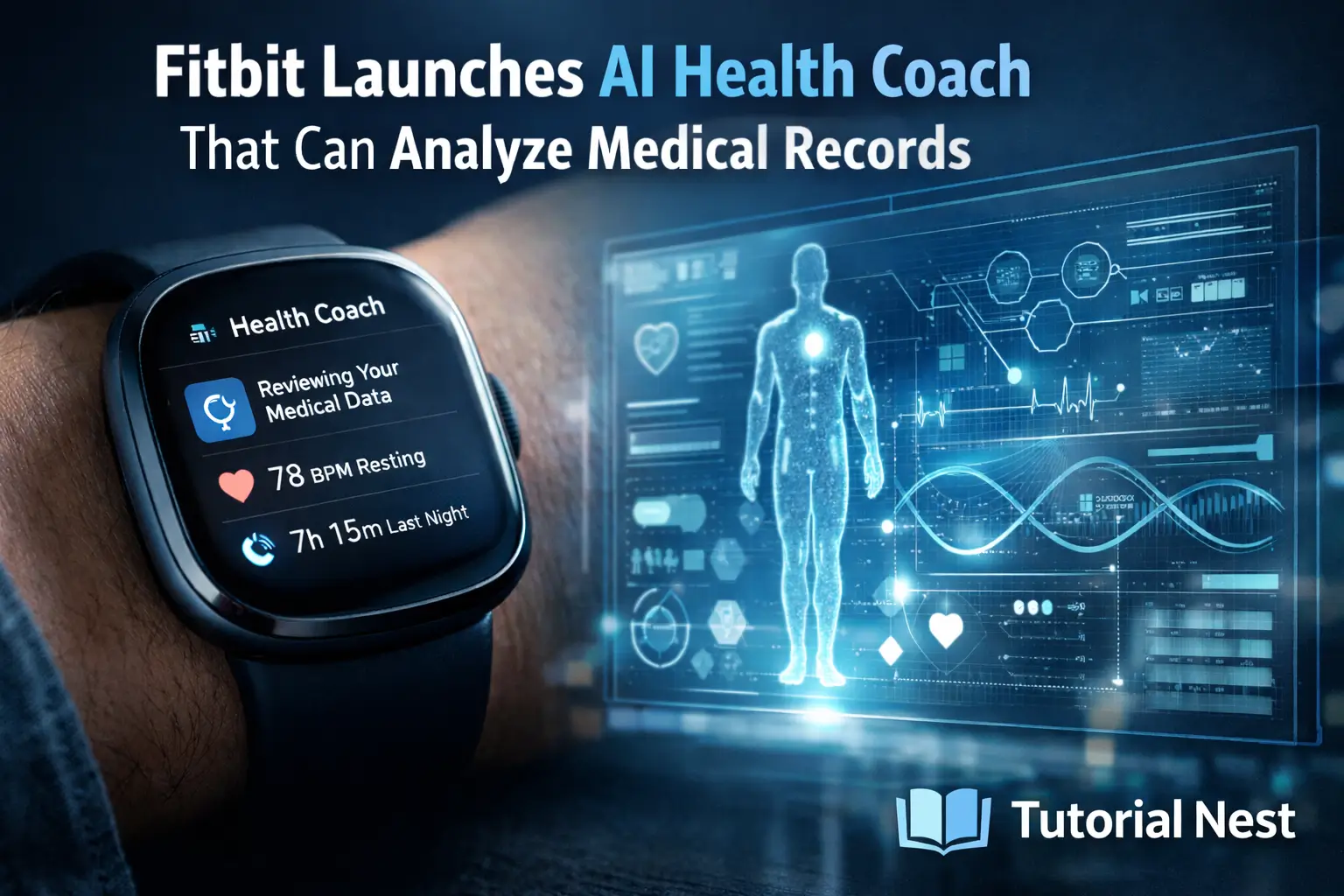
Fitbit launches AI-powered health assistant capable of analyzing medical records.
By the Nest Tutorial Editorial Team
Published on: March 20, 2026
📍 United States —
Fitbit has officially unveiled a new AI-powered health assistant capable of analyzing users’ medical history, marking a major advancement in the integration of wearable technology and digital health.
The feature, announced in March 2026, aims to provide more accurate and personalized health information by combining clinical data with real-time biometric monitoring. This initiative positions Fitbit at the forefront of a rapidly evolving industry where artificial intelligence is increasingly shaping how people understand and manage their health.
🧠 Artificial Intelligence Combined with Clinical Intelligence
According to Google , which owns Fitbit, the new AI system allows users to securely connect their medical records to their wearable devices. Once authorized, the AI health assistant can interpret a wide range of clinical data, including:
-
Medical history
-
Laboratory test results
-
Diagnosed health conditions
-
Prescribed treatments and medications (when available)
This information is then combined with the continuous stream of data collected by Fitbit devices, such as:
-
Heart rate variability
-
Stages and duration of sleep
-
Daily activity levels
-
Stress indicators
-
Oxygen saturation trends (SpO2)
-
By combining these two layers of information — clinical and behavioral — the system aims to create a holistic view of the user’s health , something that traditional fitness trackers have failed to achieve.
🔍 From general guidance to precision health
Historically, wearable devices have been based on generalized health recommendations that, while useful, often lack the specificity needed for individuals with particular medical conditions.
The new AI-powered health assistant is changing this paradigm by providing recommendations based on accuracy .
Instead of generic suggestions, users may receive:
-
Exercise guidelines adapted to pre-existing cardiovascular conditions.
-
Strategies for improving sleep based on clinical sleep disorders.
-
Nutritional suggestions tailored to metabolic or chronic conditions.
-
Alerts about patterns that may indicate emerging health risks.
-
For example, a user with a history of hypertension may receive personalized recommendations that consider both their daily activity levels and their long-term medical data. This level of personalization represents a significant step towards preventive and proactive healthcare .
🧬 The Rise of Preventive Digital Healthcare
The introduction of AI systems capable of analyzing medical records reflects a broader shift in the healthcare sector — from reactive treatment to preventative care.
By continuously analyzing historical and real-time data, tools like Fitbit’s AI coach can help:
-
Identifying the early warning signs of chronic diseases
-
Encourage healthier lifestyle choices through personalized reminders.
-
Reduce long-term healthcare costs by promoting prevention.
-
Industry analysts suggest that this type of technology could play a key role in addressing global health challenges, particularly as populations age and healthcare systems face increasing pressure.
🔐 Privacy, Security, and Data Governance
The integration of medical records into consumer devices raises important questions about privacy and data protection.
Fitbit emphasizes that the feature was designed with user control as a priority. According to the company:
-
Users must provide explicit consent before any medical data is accessed.
-
The data is not used for advertising purposes.
-
Users retain the ability to delete or disconnect their medical records at any time.
-
Furthermore, the system is expected to comply with stringent health data regulations in the regions where it is implemented, such as HIPAA in the United States.
-
However, experts note that even with security measures in place, the combination of clinical data and wearable device data represents a highly sensitive dataset. Consequently, continued scrutiny from regulatory bodies and privacy advocates is expected.
⚖️ Regulatory Landscape and Compliance
As technology companies expand their operations into the healthcare sector, regulatory oversight becomes increasingly important.
Google has indicated that the launch of Fitbit’s AI health assistant will follow regional compliance guidelines. This includes:
-
Data protection laws
-
Medical device regulations (where applicable)
-
Transparency requirements for AI-driven systems
-
In some jurisdictions, functionalities that interpret medical data may be subject to classification as Software as a Medical Device (SaMD) , which would require additional approvals and validations.
-
The pace of innovation in this sector is often faster than regulatory adaptation, creating a dynamic environment where companies need to balance speed and compliance.
⚠️ This is not a substitute for doctors.
Despite its advanced capabilities, the AI-powered healthcare assistant is not intended to replace medical professionals.
Fitbit clearly states that the system:
-
It does not diagnose diseases.
-
Does not provide medical prescriptions.
-
This should not be used as a substitute for professional medical advice.
-
Instead, the tool is positioned as a support system , helping users make more informed decisions about their health and encouraging contact with healthcare professionals when necessary.
-
Medical experts generally support the use of these tools, provided that users understand their limitations.
🏥 Integration with healthcare ecosystems
One of the most significant aspects of this development is its potential integration with broader health ecosystems.
If widely adopted, wearable devices with artificial intelligence could:
-
To promote better communication between patients and healthcare professionals.
-
To provide physicians with more continuous and detailed patient data.
-
Support for remote monitoring of chronic diseases.
This can be particularly valuable in regions where access to healthcare is limited, as wearable technology can help fill certain gaps in monitoring and preventative care.
🌍 Global launch and market availability
The AI-powered healthcare assistant is expected to initially launch in the United States as part of a limited preview program.
Fitbit has not yet confirmed a timeline for global expansion. Availability in regions such as South Africa and other international markets will likely depend on:
-
Regulatory approvals
-
Infrastructure preparation
-
Compliance with data protection
-
As with many health-related technologies, implementation strategies can vary significantly between regions.
📊 Competitive Landscape
Fitbit is not alone in exploring the intersection between AI and health.
Large technology companies are investing heavily in similar capabilities, including:
-
Apple continues to expand health features in the Apple Watch ecosystem.
-
Samsung integrates health monitoring into its Galaxy devices.
-
Other digital health startups focused on AI-based diagnostics and monitoring.
-
However, Fitbit’s approach of directly incorporating medical records into its AI system represents a differentiated strategy that could set it apart in the market.
 Amazon’s announcement regarding Prime delivery speeds and the expansion of express deliveries (official Amazon press release)
 .
.
💡 Implications for the Industry
The introduction of an AI-powered healthcare assistant capable of analyzing medical records could have far-reaching implications.
Possible impacts include:
Consumers
-
More personalized health information
-
Greater awareness of long-term health trends.
-
Greater involvement with wellness routines
Health systems
-
Improving preventive care
-
Reducing the strain on healthcare infrastructure
-
Enhanced patient monitoring capabilities
For technology companies
-
New opportunities in digital health
-
Greater responsibility regarding data privacy.
-
Increased competition in the wearable devices market.
🧾 Challenges ahead
Despite its promise, the technology faces several challenges:
-
User trust: convincing users to share sensitive medical data.
-
Data accuracy: Ensuring that AI interpretations are reliable.
-
Regulatory approval: navigating complex global regulations.
-
Ethical issues: Managing the responsible use of health data
-
Overcoming these challenges will be crucial for the long-term success of AI-based healthcare solutions.
🔮 The future of AI in personal health
The launch of Fitbit’s AI-powered health assistant reflects a broader trend toward smart, data-driven healthcare .
As AI systems become more sophisticated, future developments may include:
-
Real-time health risk prediction
-
Deeper integration with electronic health records.
-
Advanced behavioral coaching
-
Expanded use in clinical settings
-
The convergence of artificial intelligence, wearable technology, and healthcare is expected to redefine how individuals interact with their health on a daily basis.
- Amazon is also expanding its products with artificial intelligence, such as Alexa+. You can read more about the launch of Amazon Alexa+ in the UK and its new AI features in our detailed guide. ( Read here )
🧾 Executive Summary
The introduction of an AI-powered health assistant capable of analyzing medical records marks a pivotal moment for Fitbit and the digital health industry in general.
By bridging the gap between clinical data and daily health monitoring, this innovation has the potential to transform wearable devices into powerful tools for preventative care.
However, its success will depend not only on technological advancement, but also on user trust, compliance with standards, and ethical implementation.
As the boundaries between healthcare and consumer technology continue to blur, one thing is clear: the future of personal health is becoming increasingly intelligent, connected, and data-driven.